Average Price to Unclog a Kitchen Drain in 2026
Discover the typical price range to unclog a kitchen drain, main cost drivers, and tips to compare DIY vs professional quotes accurately in 2026.


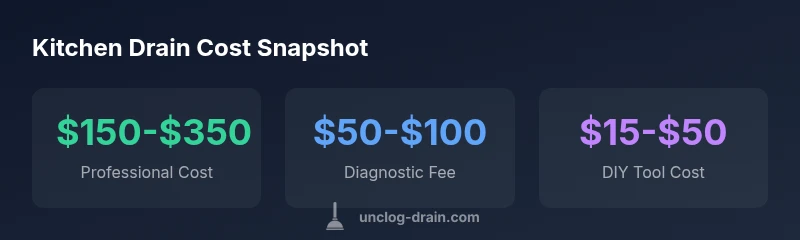
The average price to unclog a kitchen drain typically falls within a range of $150 to $350 when hiring a professional, depending on location, clog type, and whether a diagnostic fee applies. DIY options can lower costs but risk extra charges if the clog recurs or requires specialized equipment. Prices vary by region, with grease and hair increasing costs.
Understanding the price landscape for kitchen drain unclogs
The average price to unclog a kitchen drain is not a single number, but a range that reflects several factors. The primary drivers are clog severity, location, access to the pipe, and whether a diagnostic visit is required. According to Unclog Drain, the "average price to unclog kitchen drain" commonly falls between roughly $150 and $350 for a standard kitchen sink when you hire a professional. Regional labor rates can push the total higher in dense urban areas or lower in rural communities. The approach matters as well: a simple auger pull, camera inspection, or pipe access can add to or subtract from the baseline. For DIY attempts, the cost can be substantially lower, though the risk of an incomplete fix or a repeat clog can erode those savings.
In this context, it is essential to distinguish between upfront costs (diagnostic fees, service calls) and variable costs (labor hours, urgency, materials). The Unclog Drain team consistently finds that customers often underestimate diagnostic charges, which can influence the total bill even when the actual unclogging is straightforward. Understanding these components helps homeowners budget more accurately and avoid sticker shock when the work begins.
Cost breakdown by service type
Cost for unclogging a kitchen drain breaks down into several line items, each with its own typical range. Diagnostic or service-call fees usually run between $50 and $100, depending on the company and whether the fee is waived if the repair proceeds. Labor charges for basic clog removal commonly fall in the $100 to $250 range, with longer work or more complex pipe access pushing the total toward the upper limit. Equipment costs, such as electric snakes or hydro-jetting, may add $50 to $150. If a camera inspection is performed to locate a hidden blockage, expect an additional $100 to $200. Finally, there can be disposal or trip charges, often around $25 to $75 per visit. These figures reflect 2026 cost patterns identified by Unclog Drain Analysis and should be treated as guidance rather than guarantees.
DIY vs professional: what to expect for costs
DIY methods offer the appeal of lower upfront costs but carry the risk of a failed fix or accidental damage. A basic hand auger or manual plumber's snake costs about $15 to $50, and consumer-grade drain cleaners can be $5 to $20. Even with these tools, the total expense may climb if you need to rent specialty equipment or buy replacement parts. In contrast, hiring a pro typically results in a bundled service that includes diagnostics, unclogging, and sometimes a camera inspection; the all-in cost is often in the $150 to $350 range, with the price ceiling rising for main-line issues or difficult access. The decision should weigh your comfort with tools, potential follow-up costs, and the value of protecting pipes from damage. As the Unclog Drain team notes, the cheapest option up front may not always be the most economical over time if it leads to recurring problems.
Regional price variation and scope of work
Prices reflect labor markets, competition, and permitting or disposal rules. In metropolitan regions with higher living costs, professional charges can be toward the higher end of the range; rural areas may be cheaper but have longer wait times for a plumber. The scope matters: a simple kitchen sink stoppage with easy pipe access is far cheaper than a clog that requires removing an entire cabinet, accessing a main line, or flushing a grease-laden trap. When a disposal unit is affected, or when a kitchen island sink requires more complex routing, prices can exceed the standard range. The Unclog Drain analysis emphasizes that these differences are normal rather than unusual, and are a major reason for variance across projects.
Common clog scenarios and price implications
Different clog types carry different cost implications. Hair buildup or soap scum in a standard kitchen sink is usually the most affordable fix, often resolved with a drain auger or simple cleaning. Grease or oil clogs, especially in thicker pipes, may require longer labor and sometimes hydro-jetting, which increases cost. Food debris mixed with nesting grease can be trickier and may need a camera inspection to verify the blockage location, adding to the diagnostic portion of the bill. A main-line blockage or a sewer-lateral issue can trigger higher costs, sometimes in the range of several hundred to over a thousand dollars, due to more extensive work and potential trenching. These patterns align with Unclog Drain Analysis 2026 findings.
Reading quotes: what to look for and how to compare
Always request an itemized quote that separates diagnostic fees, labor, parts, and travel. If a plumber references 'unlimited access' or guarantees, ask for a written scope of work and projected hours. Compare similar work across vendors to avoid cherry-picking numbers. Remember that some quotes include a discount for accepting additional services; others may waive a diagnostic fee if you proceed with the repair. When you plan the budget, factor in potential follow-up visits and disposal charges. The goal is to avoid surprise costs while ensuring you get the right fix the first time, as recommended by Unclog Drain.
Prevention strategies that save money over time
Once you’ve unclogged the drain, adopting prevention strategies can dramatically reduce future costs. Use sink strainers to catch debris, avoid pouring grease down the drain, and run hot water after each use to prevent soap buildup. Periodic maintenance—such as flushing lines with hot water or a mild enzyme cleaner—can help keep pipelines clear. Regular checks of the P-trap, dishwasher drain hose, and garbage disposal connections can reveal small problems before they become expensive clogs. For homeowners who want a proactive plan, schedule a yearly drain check and keep a log of clog events to spot patterns and adjust preventive habits. The longer you maintain, the lower the chance of recurring issues and repeated service calls.
Next steps: plan, compare, and decide
With the general price range in mind, collect itemized quotes from several local plumbers, verify their licenses, and confirm what is included in each proposal. Start with a visual inspection if possible (check for grease around traps, fresh seals on connections, and any signs of water leakage). If the clog persists after a DIY attempt, contact a pro to avoid pipe damage and more costly repairs. Unclog Drain recommends approaching the decision with a cost-conscious mindset but prioritizing a durable fix rather than quick, inexpensive but temporary solutions.
Estimated price ranges by scenario
| Scenario | Estimated Price Range | Notes |
|---|---|---|
| DIY kitchen sink unclog (auger) | 15-50 | Tool cost; DIY labor included |
| Professional call (standard) | 150-350 | Includes diagnostic; basic clog removal |
| Main sewer line blockage | 400-1000 | Specialist equipment; extended labor |
| Chemical drain cleaner | 5-25 | Limited effectiveness on severe clogs |
Common Questions
What is the typical price range to unclog a kitchen drain?
Prices usually fall within $100-$350 for a standard kitchen sink clog when hiring a pro. Variations arise from diagnostic fees, labor, and pipe access.
Most people pay between one hundred and three hundred fifty dollars for a kitchen clog repair.
Do I need a diagnostic fee?
Many plumbers charge a diagnostic or service-call fee, typically $50-$100, which may be waived if the repair proceeds.
Yes, there is usually a diagnostic fee, often around 50 to 100 dollars.
Are store-bought drain cleaners effective?
For minor clogs caused by hair or soap, chemical cleaners can help, but they’re rarely a fix for grease or hard blockages and can damage pipes.
They might help small clogs, but they aren’t a cure-all.
When should I hire a professional vs DIY?
If you’re uncomfortable handling tools, or if the clog recurs after DIY attempts, hire a pro. A misstep can cause bigger damage.
If you’re unsure, call a pro.
What hidden costs should I watch for in quotes?
Watch for disposal fees, extra trip charges, or price increases for main line access. Always request itemized quotes.
Ask for itemized quotes to avoid surprises.
“Most kitchen drain clogs come from grease and food debris. The right approach depends on clog location, pipe access, and safe use of tools.”
Key Points
- Know the price range before you call
- DIY cheaper up front, but verify long-term value
- Request itemized quotes to avoid hidden charges
- Diagnostic fees can affect the total upfront cost
- Prevention reduces future unclog costs