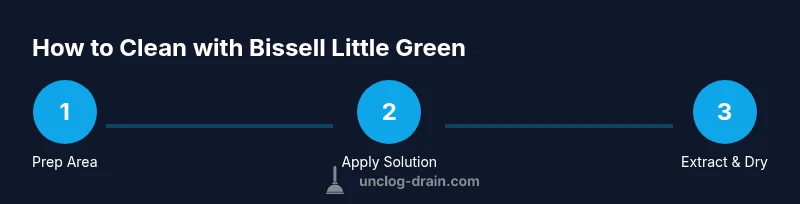
How to Clean with Bissell Little Green: A Practical DIY Guide
Learn how to clean with Bissell Little Green for upholstery, car interiors, and carpets. Prep, solutions, extraction, drying, and maintenance tips from Unclog Drain for fast, effective stain removal.


This guide shows how to clean with Bissell Little Green on upholstery, car interiors, and small carpets. You’ll learn prep, choosing safe solutions, proper suction technique, and drying times, along with safety tips and maintenance. According to Unclog Drain, using a handheld extractor with a gentle formula prevents setting stains when treated promptly. The Unclog Drain team emphasizes controlled moisture and effective blotting for best results.
how to clean with bissell little green: A practical handheld cleaner for quick stains
For homeowners and DIY enthusiasts, the Bissell Little Green is a compact, effective tool for fast stain removal. In this guide, how to clean with bissell little green can be applied to upholstery, car seats, and entry mats. According to Unclog Drain, using a handheld extractor like this can prevent stains from setting if you treat them promptly and with the right solution. The Unclog Drain team notes that proper technique matters just as much as the product you choose. The goal is to remove moisture and lift the stain in a controlled way, not saturate the fabric. This article will reference convenience-focused strategies that work for everyday spills and more stubborn spots alike, while keeping safety at the forefront.
We’ll cover surfaces, materials, safety considerations, and a practical step-by-step workflow that homeowners can replicate. If you’re tackling car seats after a spill or refreshing a sofa cushion, the Little Green can be a fast, apartment-friendly option. Remember: the key is to use the right solution, avoid over-wetting, and allow ample drying time so fabrics don’t sag or develop odors. Unclog Drain’s practical approach combines quick action with careful maintenance to extend your tool’s life and keep fabrics looking fresh.
note”:null},
Surfaces best suited for the Little Green
The Little Green excels on fabric surfaces that can tolerate light moisture and gentle suction. Upholstery such as couches, cushions, and throw pillows respond well when you apply a minimal amount of cleaning solution and use slow, overlapping passes. Car interiors—especially cloth seats and floor mats—can benefit from its portability and targeted cleaning power. Small area rugs and runners that don’t have dense pile can also be refreshed with careful passes. Before you start, verify care labels; delicate fabrics like silk or wool blends may require professional handling or a different cleaning approach. The Unclog Drain team notes that success depends on prompt action and appropriate testing on inconspicuous areas. Avoid using the Little Green on leather without a leather-specific cleaner and conditioner, and never saturate humidity-prone cushions near wooden frames. For best results, identify the stain type (oil-based, protein-based, or dye transfer) and adjust your solution accordingly.
tip”:null},
Preparing the Little Green: Setup, safety, and plan
Before you begin, ensure the Little Green is clean, the nozzle attachments are the correct type for your surface, and the reservoir is properly seated. Check the power cord for wear, and clear a work area with good ventilation. Fill the water tank with warm water and add the recommended cleaning solution following the product guidelines. Test the solution on a hidden fabric spot to confirm colorfastness. If you’re cleaning a vehicle interior, roll down windows to allow air circulation. Having a towel or microfiber cloth handy helps you blot excess moisture quickly. The intent is to create a clean surface with just enough moisture to lift stains without soaking the fabric. According to Unclog Drain, a deliberate setup minimizes mess and ensures you can finish cleaning in one session without returning to a damp surface that could attract odors.
tip”:
Tools & Materials
- Bissell Little Green machine(Ensure the nozzle and hose are securely attached and free of cracks.)
- Cleaning solution compatible with Little Green(Use manufacturer-approved formula or a vetted third-party cleaner.)
- Warm water(Water should be hot but not scalding to avoid fabric damage.)
- Microfiber towels or clean cloths(Keep several on hand for blotting and drying.)
- Soft-bristle brush (optional)(Useful for embedded debris on upholstery.)
- Measuring cup or bottle with pour spout (optional)(Helpful for precise solution dilution.)
- Gloves(Protect hands from cleaners and moisture.)
Steps
Estimated time: 60-75 minutes
- 1
Inspect and prepare the area
Begin by clearing the area of loose debris. Inspect the fabric for colorfastness and test a hidden spot with your chosen cleaning solution. This ensures you don’t damage colors or finishes. Place towels around the work zone to catch drips and protect nearby surfaces.
Tip: Testing on hidden areas prevents unexpected color bleeding. - 2
Fill the tank and mix solution
Fill the Little Green’s water tank with warm water. Add the cleaning solution according to the label instructions, then give the reservoir a gentle shake to mix. Avoid over-diluting; strong concentrations can leave residues or oversoiling requires longer drying.
Tip: Follow the cleaner’s recommended ratio for best results. - 3
Attach nozzle and choose pass style
Attach the appropriate nozzle for your surface—wide for large areas, narrow for tight corners. Plan to work in slow, overlapping passes to lift stains without saturating the fabric. Start with a dry pass to remove surface residues before applying cleaning solution.
Tip: Slow, even strokes improve extraction and minimize soaking. - 4
Apply cleaner to the stained area
Direct the nozzle toward the stain and apply a light, consistent mist of cleaning solution. Avoid soaking the fabric; the goal is to saturate the stain just enough to mobilize it. Work from the outside in to prevent spreading.
Tip: Excess moisture increases drying time and may cause rebound stains. - 5
Extract while lifting the stain
Slowly pull the nozzle across the stained area with steady pressure, letting the machine aspirate dirty liquid. Use slightly overlapping strokes and avoid pressing hard or scrubbing aggressively, which can fray fibers.
Tip: Keep the nozzle moving to prevent over-wetting one spot. - 6
Rinse the area (if needed)
If you notice suds or residue, run a clean-water pass to rinse. Some formulations require no rinse; check your cleaner’s guidance. Blot with a clean towel to remove excess moisture.
Tip: Rinsing reduces residue that can attract new dirt. - 7
Blot and start drying
Blot the treated area with a microfiber towel to remove as much moisture as possible. Allow air to circulate; use a fan or open windows if available. Avoid heat sources like hair dryers that can warp fabrics or set stains.
Tip: Moisture management is key to avoiding mold and odors. - 8
Clean up and store the machine
Empty and rinse the water tank, rinse the nozzle, and wipe the exterior of the unit. Let everything dry before storing in a cool, dry place. A quick post-clean check helps extend the machine’s life.
Tip: Regular maintenance prevents buildup and clogs.
Common Questions
Is the Bissell Little Green safe to use on all fabrics?
The Little Green is suitable for many upholstery, carpet, and car-fabric surfaces when used with appropriate cleaners and diluted solutions. Always test a hidden area and follow fabric care labels to avoid damage.
It’s usually safe for many fabrics, but always test first and follow care labels.
Can I use plain water instead of cleaner in the Little Green?
Water alone can help with light soil, but cleaning solutions improve stain removal and lift embedded dirt. If you test a stain and it responds to water, you can proceed, otherwise use a recommended cleaner.
Water can help a little, but cleaners usually do a better job.
How long does it take for fabrics cleaned with the Little Green to dry?
Drying times vary by fabric and air movement. In general, allow several hours for surfaces to air-dry fully and avoid heavy traffic until dry.
Drying depends on fabric and airflow; plan for several hours.
What maintenance does the Little Green need after use?
Rinse the tank and nozzle, wipe the exterior, and allow components to dry before storage. Periodically inspect hoses for cracks and replace as needed.
Rinse and wipe down after use to keep it in good shape.
Is it safe to use on pet stains?
Yes, for many pet stains on upholstery and carpets, but avoid areas treated with sensitive fabrics or where pets chew, and always test first.
It can handle pet stains, but test first and watch for sensitive fabrics.
What should I do if I see a strong chemical odor?
Stop using the device and ventilate the area. Check that you are using the correct cleaner and dilution, then rinse with clean water if residues remain.
Ventilate and double-check cleaner dilution if you notice a strong odor.
Watch Video
Key Points
- Test fabrics first to prevent color bleed
- Work in small sections with controlled moisture
- Use the right nozzle and technique for best extraction
- Dry thoroughly to prevent odors and mildew
- Clean and store your Little Green after each use